 EN
EN DE
DE RU
RU FR
FR AR
AR FA
FA NL
NL ES
ES FI
FI SV
SV DA
DA ZH
ZH ZH-HK
ZH-HK
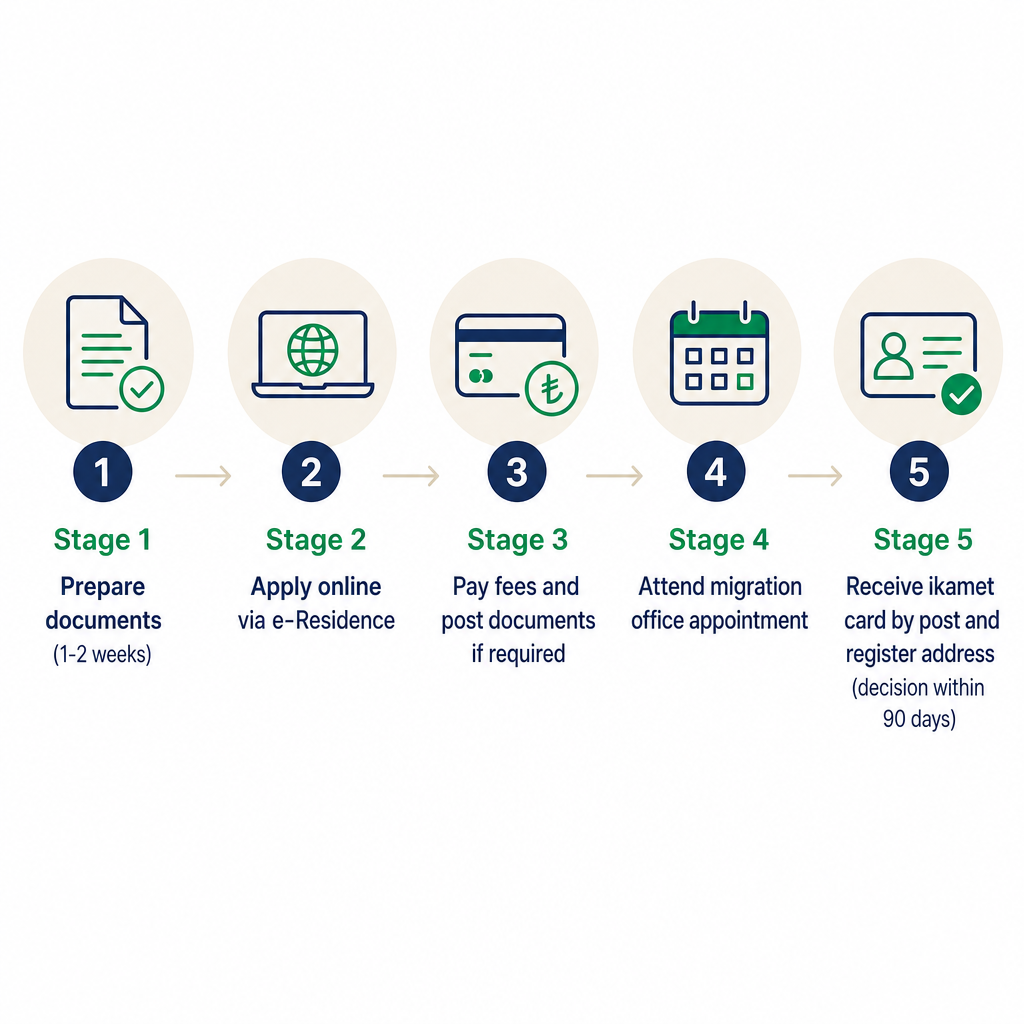
Owning a home on the Aegean coast can open the door to living in Turkey long term, and for most Kusadasi property owners the route runs through a short-term residence permit tied to that property. Learning how to apply for a Turkey residence permit is far less daunting once you see the shape of it: you file online through the official e-Residence system, attend an appointment at your local migration office, and receive your ikamet card by post. Realistically, plan for roughly one and a half to four months from starting the form to holding the card, and budget a few hundred euros equivalent per adult once official fees, health insurance, translations and notary charges are counted. Exact figures shift with your nationality, age and requested length of stay, so they always need checking at the time you apply.
At Property Kusadasi we have guided international buyers through this process since 2001, and after your purchase we routinely help coordinate paperwork, appointments and legal support so you are not navigating the system alone. This guide walks through the prerequisites, the ordered steps, the mistakes that trip people up, and the point where local help genuinely earns its place.
Table of contents
What the permit gives you, and what it costs
A typical first residence permit in Turkey based on property ownership is a short-term permit, usually issued for one to two years. The card, known as an ikamet, lets you live in Turkey, register your address, open bank accounts and stay well beyond ordinary visa limits. That legal footing is what makes settling in, whether for a holiday base or full-time retirement, practical rather than a series of border runs.
The money side splits into a handful of predictable items per adult. There is a residence permit processing fee and a separate card fee, both varying by nationality and the duration you request. On top sit private health insurance for the requested period, and the smaller but unavoidable costs of notary work, sworn translations and photocopies. One published guide cites a document fee of around 964 TRY for certain applicants, alongside the permit and card fees. None of these are fixed in stone; government tariffs change, and your age and requested stay move the total, so treat any figure you read as indicative until confirmed on the day.
Prerequisites checklist before you apply
Getting these basics in place before you touch the online form prevents most delays.
- Legal presence in Turkey. You must hold a valid visa or visa-free entry and remain within your permitted stay until the application is lodged and processed.
- A qualifying property in an open district. You hold a valid title deed (tapu) in your name, and the district still accepts new residence permit applications. Many areas with high foreign populations have introduced restrictions, so this needs checking in advance.
- Value thresholds for investment routes. If you are using an investment-based track, the cadastral value must meet the current minimum (often around 200,000 USD for some property-based tracks) and the property must be free of liens and debts.
- Passport validity. Your passport should typically remain valid at least 60 days beyond the requested permit period.
- A Turkish tax number. You need this to pay fees and complete registrations.
- Proof of address. Your ownership documents, or a notarised rental contract where relevant, plus later registration of your address in the national system within the required window after approval.
- Compliant health insurance. Private cover meeting Turkish requirements for the full requested period is mandatory for most adults.
- Financial means. Bank statements or income proof consistent with your declared purpose.
- Biometric photos and copies. Recent biometric photos plus photocopies of your passport, entry stamp, title deed and supporting documents.
We routinely help buyers check neighbourhood status, property eligibility and document requirements before they commit to apartments in and around Kusadasi or seafront and hillside villas, so the property actually supports the residence plans built around it.
Step by step: applying as a property owner
1. Choose the correct permit type and purpose
Most property owners apply for a short-term residence permit based on owning real estate. Your declared purpose must match reality: describing employment or permanent settlement as tourism, or mislabelling a passive investment, is a frequent cause of refusal. Pick the category that reflects your genuine situation.
2. Confirm neighbourhood and property eligibility
Before you buy, or before you file if you already own, verify that the district is open for new residence permits, that the property meets any value threshold for your intended route, and that the title deed is clean and correctly registered. We monitor local rules across Kusadasi and the surrounding Aegean and can steer you towards properties more likely to meet current criteria.
3. Prepare your full document set
Compile a file tailored to your permit type: the printed and signed application form and appointment slip, passport with copies of relevant pages, recent biometric photos, the title deed with any valuation or tax statements needed to verify value, your health insurance policy covering the permit period, and proof of financial means plus family relationship documents where relevant. Foreign-language documents usually need sworn translation and notarisation, so build extra time and cost into your plan.
4. Complete the online e-Residence (e-İkamet) application
Standard applications go through the official e-Residence system of the Directorate General of Migration Management. You create an account, fill in personal, travel and accommodation details, select the property-ownership basis, upload your biometric photo where requested, and confirm the information. Save your unique application number, which you will need for payments and tracking. The system then assigns an appointment at your local Provincial Directorate of Migration Management (Göç İdaresi).
5. Pay the assessed fees
Expect a residence permit processing fee, a residence card fee, and any single-entry visa fees that apply to your nationality. Payments are often made online through the tax administration system, or in person at tax offices and PTT branches, using your application number. Keep every receipt in your file, as they are checked at the appointment.
6. Submit physical documents if required
Some provinces require you to post or deliver the physical file within a set period, often within five working days of completing the online application. Missing that window can lead to cancellation, so treat the posting deadline as seriously as the appointment itself.
7. Attend your migration office appointment
On the scheduled date, attend in person with your original documents and organised copies, the printed application form and appointment slip, and your payment receipts. Officials check and receive your documents, biometric data such as fingerprints may be taken, and you may receive a registration certificate allowing you to remain in Turkey while the file is processed. We can help you prepare for this appointment and coordinate with local lawyers or translators where needed.
8. Wait for the decision and track your file
The Directorate General of Migration Management is expected to decide within 90 days of complete documents reaching the competent authority. You can track the status online using your application number, and you may be contacted for additional documents within a specified window, so keep an eye on your account and communication channels.
9. Receive your card and register your address
If approved, the card is posted to your registered address. Verify every detail, name, dates and permit type, as soon as it arrives. First-time applicants must complete address registration duties within the applicable timeframe, often within 20 working days of approval. Registering for the official electronic communication system (UETS) at a PTT branch can make government notices more reliable to receive.
Realistic timeline for coastal applicants
Experiences vary by province and workload, but for property owners on the coast a sensible expectation is one to two weeks to prepare documents, longer where translations and valuations are involved. Appointment scheduling commonly falls two to eight weeks from the online application, and the decision can take up to 90 days, though straightforward cases sometimes clear in two to eight weeks.
Taken together, plan for around one and a half to four months from starting the form to holding your card. The practical consequence is worth flagging: avoid booking long international trips that could clash with your appointment date or your address-registration window, because those fixed dates rarely move to suit your calendar.
Common mistakes and how to avoid them
Misdescribing your purpose. Relabelling employment or permanent settlement as tourism, or misrepresenting investment motives, invites refusal. Choose the category that matches your actual situation.
Applying from a restricted district. Some high-density areas no longer accept new short-term permits, especially on tourism grounds. Confirming the neighbourhood remains eligible before you buy is far easier than discovering the problem afterwards.
Inconsistent documentation. Names, passport data, address, insurance and financial figures must align across every document. Gaps or contradictions trigger requests for more evidence, or a refusal.
Underestimating passport and insurance rules. A passport expiring too soon, or insurance that does not cover the full requested period, is a common and entirely avoidable stumble.
Missing posting or registration deadlines. Where documents must be posted within a few days, late submission can cancel the application, and failing to register your address in time causes administrative headaches.
Ignoring rule changes. Value thresholds and district closures shift frequently. Check the current position before you apply or buy, rather than relying on last year's guidance.
Doing it yourself versus using a local expert
The e-Residence system is designed so individuals can complete straightforward applications alone, which works well for simple tourist or student cases. Property-based permits and investment strategies are a different matter, and professional guidance genuinely pays off when you are buying specifically to support a residence permit or an eventual Turkish citizenship by investment, when you are including a spouse or children and must coordinate several files at once, when your case involves a previous refusal or mixed-purpose stays, or when Turkish language and local district rules are unfamiliar territory.
This is where our role becomes practical rather than promotional. As a licensed local consultancy in Kusadasi we help you choose a suitable property, coordinate with lawyers and government offices, and keep you on track from the online application through to address registration. For overseas investors and retirees who value a calm, well-managed transition, that continuity removes much of the stress that otherwise surrounds a foreign bureaucracy. Our companion piece on the residence permit route through property ownership sets out how the two decisions fit together.
Choosing a Kusadasi property that supports your permit
Kusadasi offers a broad spread of options, from central apartments convenient for year-round living to quieter coastal villas suited to retirement or holiday use, along with building plots for custom homes. When your goal includes a residence permit or a later citizenship option, three factors deserve early attention.
Favour districts that remain open to residence permit applications and are attractive for long-term living. Make sure the property comfortably meets any current threshold for investment-based routes, with clean, complete paperwork behind it. And weigh lifestyle fit honestly: proximity to healthcare, shopping, the seafront promenade and transport links matters a great deal if you intend to live or retire here full-time rather than visit occasionally.
Our neighbourhood guide for home buyers and first-time buyer guide to Kusadasi property, together with one-to-one advice, help you align property choice, lifestyle and legal route from the outset, so the residence permit you want later is not undermined by a purchase decision made without it in mind.
Frequently asked questions
How long is a residence permit valid for property owners?
Short-term permits linked to property ownership are often issued for one to two years, subject to the authorities' discretion and your documented purpose.
Can I include my spouse and children on my application?
Family members usually apply separately but can base their applications on your status and shared accommodation, providing their own passports, insurance and relationship documents. Local legal advice ensures the correct route is used.
Do I need to live in the property full-time?
Many property-based permit holders are not required to stay in Turkey continuously, but prolonged absences or a pattern of stay inconsistent with the declared purpose can raise questions. Rules and practice vary, so personalised advice helps.
Is owning a property enough to guarantee a permit?
No. Ownership helps but does not guarantee approval. The migration authorities examine your whole situation: legal stay, documentation quality, neighbourhood status, financial means and consistency of information.
What happens if my application is refused?
Depending on the reason, you may be able to correct the issues and reapply, or pursue administrative or judicial remedies. Acting quickly and seeking professional support matters here.