 EN
EN DE
DE RU
RU FR
FR AR
AR FA
FA NL
NL ES
ES FI
FI SV
SV DA
DA ZH
ZH ZH-HK
ZH-HK

Buying property in Kusadasi as a foreign national is more straightforward than many overseas buyers expect: you view, run legal checks, convert funds properly, and register the title deed (tapu) in your name at the Land Registry. Learning how to buy a property in Kusadasi really comes down to understanding a handful of Turkish rules, working with a licensed local agency, and keeping the paperwork clean from your first viewing through to completion. We have been active in this market since 2001, and this guide walks you through the mechanisms, the options, and the decisions that shape a secure purchase on the Aegean coast.
Table of contents
Can foreigners buy property in Kusadasi?
Yes. Foreign nationals from most countries can buy property in Turkey as freehold owners, with full ownership registered on the official title deed (tapu) at the Land Registry. Turkey removed the old reciprocity requirement in 2012, so citizens of many states can purchase apartments, villas and other real estate broadly on the same terms as Turkish citizens.
There are exceptions worth knowing before you fall in love with a listing. Nationals of certain countries, including Armenia, Syria, North Korea, Nigeria, Cuba and Yemen, are not permitted to buy property in Turkey. Foreign ownership is also subject to national limits: caps on the total area a single foreign individual may own, and on the proportion of privately held land within any given district.
When you buy a home in Kusadasi, your tapu records you as the legal owner and sets out the property type, your share, and any restrictions or mortgages attached to it. For most international buyers this delivers secure, long-term freehold ownership suitable for holiday use, rental income, or retirement. If you would like to understand the broader appeal of the region first, our overview of why buyers choose the Turkish Aegean coast sets the scene.
Property options: apartments, villas and land
Kusadasi sits on Turkey's Aegean coast, blending a lively resort atmosphere with settled residential neighbourhoods, marinas, shopping and quick access to Izmir airport. That mix supports several property types, each suiting a different budget and lifestyle.
Apartments for sale in Kusadasi are the natural choice for holiday-home buyers and investors. They range from compact one-bedroom units in resort-style complexes to spacious family flats near the town centre or marina. Modern developments often include pools, security, parking and shared gardens, which makes them practical for lock-up-and-leave ownership and short-term rentals. You can browse current apartments in Kusadasi to gauge layouts and locations.
Villas for sale in Kusadasi suit extended stays, family holidays and full-time living. Options run from hillside villas with sea views to homes in gated communities with shared facilities, and many feature private gardens, terraces and pools. Our villa listings show the range across residential complexes and standalone plots.
Land and development plots appeal to buyers who want to commission their own build and control every detail. This route needs careful zoning and planning checks, so it is best handled with local support; our land listings are a starting point for that conversation. One caution for citizenship-minded buyers: empty, undeveloped land without buildings does not qualify under the latest citizenship-by-investment guidance.
The legal and financial framework
Getting the legal and money side right is what turns a hopeful purchase into a secure one. Turkish law allows foreign individuals from most countries to own residential and commercial property, provided their nationality is on the list approved by the President. Ownership is recorded at the Land Registry (Tapu ve Kadastro), and the tapu is the key document proving your rights.
Before committing, three conditions must hold: your nationality must be eligible; the property must not sit in a military or otherwise restricted zone; and any mortgages, liens or other encumbrances must be checked on the land registry extract. Working with a licensed agency and an independent lawyer is how these checks get done properly.
Required documents and valuation
Foreign buyers usually need the following:
- A valid passport, with a notarised Turkish translation where required.
- A Turkish tax number (Vergi No), obtainable in person from a tax office in around 30 minutes.
- An official property valuation report from a Capital Markets Board (SPK)-licensed valuation firm, which confirms market value and is mandatory before transfer.
- Compulsory DASK earthquake insurance, required for registration and for connecting utilities.
- Proof of payment by bank transfer, so the Land Registry can confirm the amount and source of funds.
The SPK appraisal does double duty: it checks whether the declared sale price is reasonable, and for citizenship applications it verifies that the required investment threshold has been met.
Currency exchange and payment
If you are paying in foreign currency, Turkish regulations require conversion into Turkish lira through an authorised bank, which issues a Foreign Exchange Purchase Certificate (Döviz Alım Belgesi – DAB). The DAB documents the amount converted and forms part of the purchase file presented at the Land Registry. For larger transactions, and especially for citizenship applications, payments must be traceable through the banking system, with bank receipts linking buyer and seller and matching both the valuation and the contract.
Taxes and fees
When the title deed transfers, a statutory transfer tax of 4% of the declared base value is payable to the tax office, typically shared between buyer and seller by agreement. There are also modest administrative and notary fees for the Land Registry, translations and local registrations. We set out expected total costs early so you can budget with confidence rather than facing surprises on completion day.
The buying process from viewing to title deed
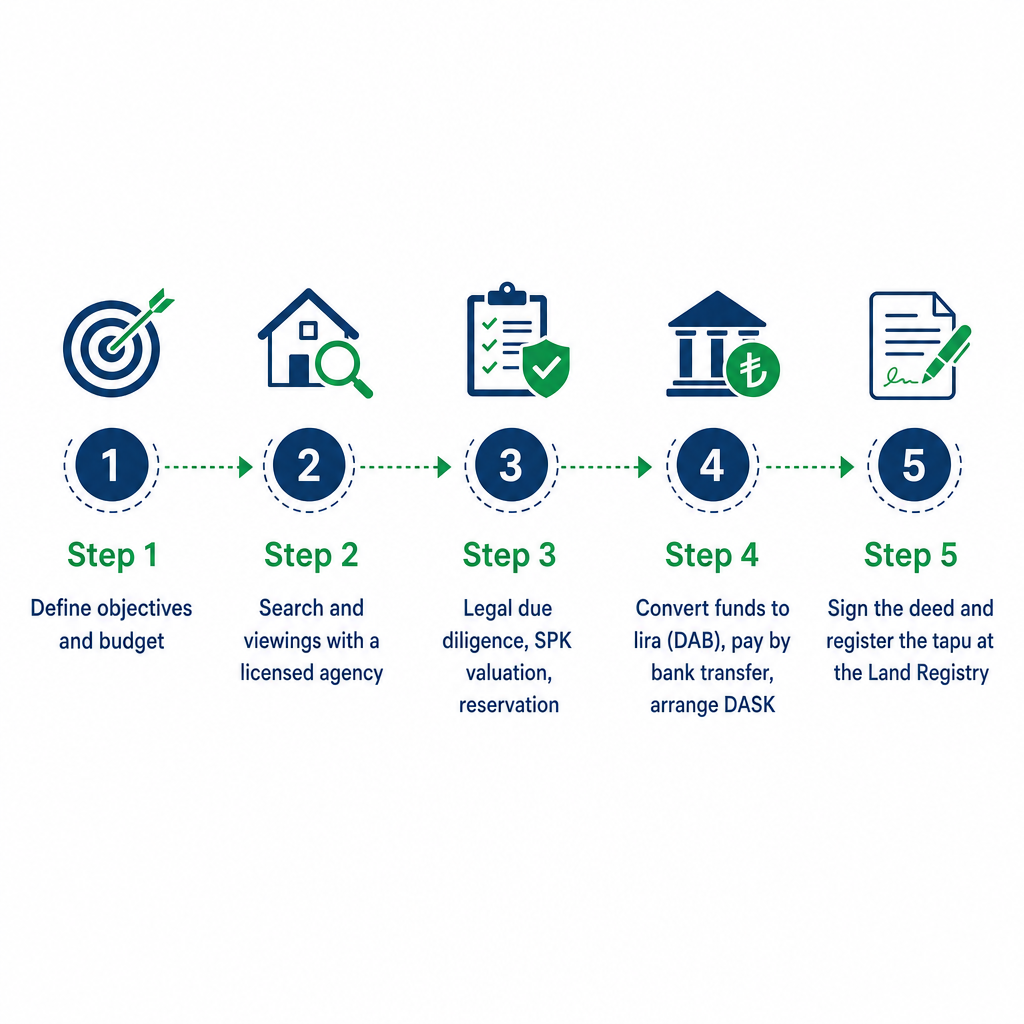
Every purchase is a little different, but the legal sequence under Turkish law is consistent, and following it in order is what protects your money.
Clarify objectives and budget. Decide whether you want a holiday home, a rental investment, or a base for living or retiring in Kusadasi, and whether a residence permit or citizenship is part of the plan. Cash or finance matters too. Clear objectives let us shortlist the right properties and areas rather than showing you everything.
Search and viewings. We help you shortlist properties for sale in Kusadasi against your criteria, then use viewings to compare locations, build quality, on-site facilities, estimated running costs and rental potential side by side.
Due diligence and reservation. Once you choose a property, the land registry extract (tapu kaydı) is obtained to review ownership, mortgages, court orders and other annotations. Zoning and building compliance are checked at the municipality to confirm the building matches approved plans and carries no demolition orders or fines. An SPK-licensed appraisal is commissioned to establish the official value. If you proceed, a reservation agreement is signed and a deposit is usually paid, subject to satisfactory checks, with your lawyer reviewing contracts and any powers of attorney.
Currency conversion and payment. Foreign currency is converted to lira via a Turkish bank, generating the DAB certificate. Payment is made by bank transfer, with receipts kept to prove the amount and parties, and DASK insurance is arranged for the Land Registry. We co-ordinate these steps and liaise with your lawyer and the seller.
Title deed transfer. On completion day, buyer and seller (or their attorneys) sign the official deed (resmî senet) before the land registry officer, the transfer tax and registry fees are paid, and the tapu is issued in your name. If you are buying under the citizenship route, a three-year non-sale annotation is added to the tapu, confirming the property cannot be sold during the required holding period.
After-sales. Once the keys are yours, we can help with utility connections, furniture packages, setting up rentals and property management, and applications for a residence permit or citizenship where eligible. This ongoing support matters most for buyers who are not in Turkey year-round.
Residence permit and Turkish citizenship routes
Property in Kusadasi can do more than provide a home; it can underpin your right to stay. Foreigners who acquire property in Turkey are eligible for renewable short-term residence permits under Law No. 6458 on Foreigners and International Protection, with the tapu serving as the basis for the application.
Typical residence permit requirements include a valid passport and biometric photos, proof of property ownership and address registration, health insurance valid in Turkey for the permit's duration, and the application forms and fees submitted to the Provincial Directorate of Migration Management. As long as you continue to meet the legal conditions, this renewable status can support living or retiring in Kusadasi over the long term.
Turkish citizenship by investment
If citizenship is your primary objective, Kusadasi offers qualifying properties that fit the national programme. Under the current real estate route, applicants must:
- Purchase one or more qualifying properties with a total officially appraised value of at least USD 400,000 (or the lira equivalent at the Central Bank rate on the transaction date).
- Obtain an SPK-licensed valuation report confirming the property meets or exceeds this threshold.
- Register a three-year non-sale restriction on the title deed.
- Complete payment via traceable bank transfer, documenting the flow of funds from buyer to seller.
- Secure a Certificate of Conformity from the relevant ministry confirming the investment qualifies.
Once these steps are complete and the application is approved, the investor, spouse and minor children can be granted Turkish citizenship under Law No. 5901. Qualifying properties can include apartments and villas, and, subject to current regulations, buildings on land with recognised ownership status; undeveloped land alone does not qualify. We help clients identify properties likely to meet the valuation threshold, co-ordinate SPK valuations and tapu restrictions, and align the purchase with application timing.
Risks and how we help you manage them
Buying in Kusadasi is safe when the process is structured correctly, but a few risks deserve attention.
| Risk | Why it matters | How it is managed |
|---|---|---|
| Restricted locations | Properties near military or sensitive zones can be off-limits to foreign ownership | Early eligibility and zone checks before viewing |
| Title or zoning problems | Mortgages, court orders or plan discrepancies can affect your rights or trigger fines | Land registry extract and municipal compliance checks |
| Incorrect valuations | Non-SPK valuations can block tapu registration and invalidate citizenship applications | Insist on SPK-compliant appraisals |
| Undocumented payments | Skipping the DAB or paying cash can stop registration or disqualify citizenship | DAB certificate, bank transfers and complete records |
We reduce these risks by working only with verified listings, co-operating with reputable lawyers and SPK appraisers, and confirming that the DAB, bank transfers and documentation are all in order before completion.
Deciding what and where to buy
When you weigh how to buy a property in Kusadasi, the decision usually turns on four questions.
Purpose. A holiday home, a long-term residence, a rental investment, or a citizenship and residence strategy each point towards different properties and neighbourhoods.
Type and budget. Apartments tend to offer lower entry costs and easier maintenance; villas provide more space and privacy; land and self-build projects give the most customisation but carry the most complexity.
Location and lifestyle. Consider proximity to beaches, the town centre, public transport, healthcare and schools, and the character of each neighbourhood.
Legal and immigration goals. For a residence permit, most suitable residential properties can serve as a basis. For citizenship, your portfolio must meet the USD 400,000 threshold and the three-year holding condition, so the valuation and paperwork need to be planned from the start.
Talking through these criteria with us early keeps the search focused only on properties that genuinely match your objectives, budget and timeline, so you view fewer homes and reach a confident decision faster.
Frequently Asked Questions
Can I buy a property in Kusadasi as a non-Turkish citizen?
Yes. Most foreign nationals can buy property in Turkey with full freehold ownership recorded on the tapu, subject to nationality eligibility and location restrictions.
Are there nationalities that cannot buy property in Turkey?
Yes. Citizens of certain countries, including Armenia, Syria, North Korea, Nigeria, Cuba and Yemen, cannot purchase property in Turkey under current rules.
What documents do I need to buy an apartment or villa in Kusadasi?
Typically a passport, a Turkish tax number, an SPK valuation report, DASK earthquake insurance and proof of payment by bank transfer, plus any required translations and local forms.
Will buying a property in Kusadasi give me a residence permit?
Foreigners who acquire property in Turkey can apply for renewable short-term residence permits under Law No. 6458, using the property as the basis for their stay.
How much must I invest to obtain Turkish citizenship by investment?
You must purchase one or more qualifying properties with an officially appraised value of at least USD 400,000, hold them for at least three years, and meet the other documentation and security requirements.