 EN
EN DE
DE RU
RU FR
FR AR
AR FA
FA NL
NL ES
ES FI
FI SV
SV DA
DA ZH
ZH ZH-HK
ZH-HK

Owning qualifying residential property in Turkey can open the door to living long-term on the Aegean coast, but a turkish residence permit through property is neither automatic nor unconditional. Buying a home gives you the legal basis to apply for a renewable short-term residence permit; approval still depends on value thresholds, documentation and the migration authorities' assessment. For international buyers weighing property for sale in Kusadasi, this route is often the most practical way to turn a holiday home into a genuine base for living or retiring on the coast, provided the property and paperwork meet current rules.
Table of contents
What a property-based residence permit actually is
Under Turkish migration law, foreign nationals who own residential real estate in Turkey may apply for a short-term residence permit (kısa dönem ikamet izni) based specifically on that ownership. This is sometimes called a property-based residence permit or residence permit for property owners, and it is a sub-category of the short-term permit regulated by Law No. 6458 on Foreigners and International Protection.
The permit grants a legal right to reside in Turkey for a limited period, often up to one or two years, with the possibility of renewal for as long as the qualifying conditions continue. It is aimed at people who genuinely live in Turkey in their own home, rather than those who only visit occasionally or hold the property purely as an investment.
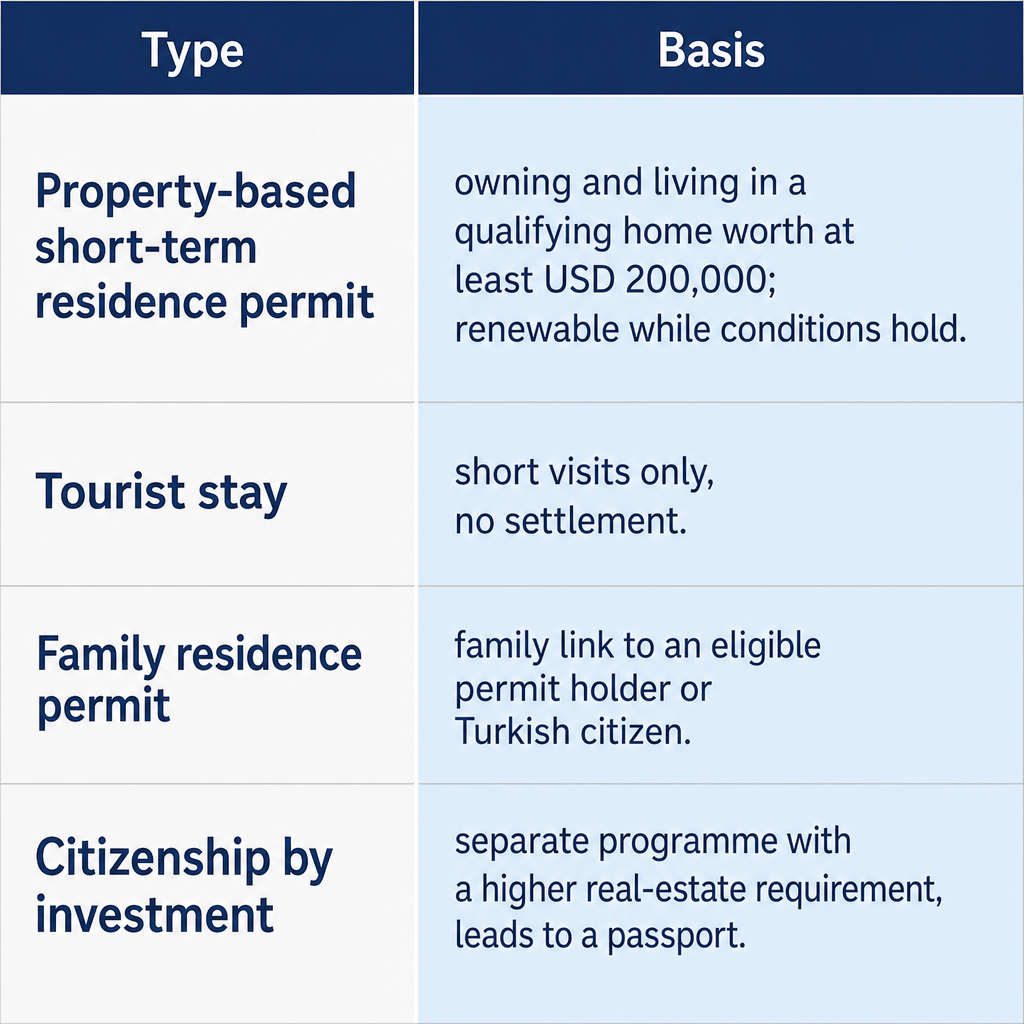
This matters because the property route is distinct from three other things buyers often confuse it with: a tourist stay, long-term residency, and citizenship. A tourist visa or visa-free entry does not let you settle. Long-term residency and citizenship carry heavier requirements. The property-based short-term permit sits between them, offering a renewable and comparatively accessible way to establish a home base. For buyers looking at apartments or villas for sale in Kusadasi, it is usually the natural first step from holiday ownership to year-round living.
One detail worth stressing early: you do not need a residence permit to buy the property in the first place. Foreign nationals can purchase residential real estate and obtain the title deed, and it is that ownership which then makes you eligible to apply for the permit.
The legal requirements that decide eligibility
Eligibility rests on a small number of firm conditions. Miss any one of them and the property route closes, regardless of how attractive the home is.
Residential ownership proven by TAPU
You must legally own a residential property, evidenced by a registered title deed (TAPU) in your name. The property has to be zoned and registered as housing and be suitable for habitation, and it must be used as your home rather than purely as a commercial space. Ownership is recognised only once the TAPU is issued and registered at the Land Registry; preliminary sales contracts or notary promises do not confer legal ownership. The home must also sit outside restricted military or security zones where foreign ownership or residence is limited.
A minimum value of USD 200,000
Recent regulatory changes introduced a nationwide minimum value for permits based on real estate. The residential property used for the permit must be worth at least USD 200,000, or the equivalent in Turkish lira on the date of purchase. This unified threshold replaces earlier, lower minima that varied between metropolitan and other provinces.
In practice, lower-cost studios or older apartments may no longer qualify, while mid-range and higher-value apartments and villas in Kusadasi typically can, as long as their official valuation meets or exceeds the threshold. Because exchange rates and official appraisals move, it is sensible to aim comfortably above USD 200,000 rather than sitting exactly on the line.
Duration, renewal and the ownership link
Property-based permits are usually issued initially for up to one to two years, at the discretion of the migration authorities. They are renewable so long as you keep the property, continue using it as a residence, and satisfy the other conditions such as insurance, financial means and a clean record. Because the permit is explicitly tied to owner-occupation of a qualifying home, selling the property or renting it out contrary to the residence-use requirement can undermine your basis for renewal.
Eligibility is not approval
Buying a qualifying property does not automatically grant a permit. Ownership gives you a legal basis to apply; it does not guarantee a decision in your favour. You still submit a full application through the official e-residence system and attend an appointment at the Provincial Directorate of Migration Management, where the authorities assess your documents, financial situation, insurance and compliance with current rules before deciding. The property is necessary, but not sufficient on its own.
How the property route compares with other pathways
Turkish migration law offers several routes, and choosing well depends on why you want to be in Turkey.
The property-based short-term residence permit is built around owning and living in a home worth at least USD 200,000, renewable while you keep the property and comply with the rules. Beyond it sit other short-term categories granted for reasons such as business connections, studies, language courses, medical treatment or tourism, all regulated under the same Law No. 6458. Family residence permits exist for non-owner spouses and children, usually based on a family link to someone who already holds an eligible permit or is a Turkish citizen.
Turkish citizenship by investment is a separate programme altogether. It requires a significantly higher real estate investment and additional conditions, and it leads to a passport rather than a renewable stay. For many buyers considering property for sale in Kusadasi mainly for lifestyle reasons, the property-based permit is more flexible and affordable than targeting citizenship straight away, while still allowing year-round living. If a Turkish passport is genuinely the goal, that decision reshapes the budget and the type of property you should be viewing from the outset, which is worth settling before you start.
How the permit works in practice
Two things determine how smoothly this route goes: choosing the right property, and handling the application correctly.
Choosing property in Kusadasi with residency in mind
If a residence permit is your goal, the property choice is not just about the view. It must be residential and suitable as a home, not land or a purely commercial unit. Its valuation should comfortably exceed the USD 200,000 threshold to absorb exchange-rate movements and appraisal differences. The title deed should be registered cleanly in your name, or in the names of co-owners in your family where you plan to apply together.
As a long-established local agency on the Aegean coast, we help buyers identify apartments for sale in Kusadasi and villas for sale in Kusadasi that match both lifestyle goals and current residence-permit rules. That usually means talking through neighbourhoods, budgets and property types together, so the home you fall for is also one that supports your plans for living or retiring here. If your interest is in land instead, it is worth knowing early that a plot alone will not support this particular permit route.
The application mechanism
Once you hold your TAPU and have moved in, the application generally follows a clear sequence:
- Online application. You complete an application via the official Directorate of Migration Management e-residence portal, selecting the short-term category based on property ownership.
- Document preparation. You gather the required documents, which commonly include a passport and biometric photos, the TAPU proving ownership and value, proof of address and a Turkish tax number, health insurance covering your intended stay, evidence of sufficient financial means, and payment receipts for the permit and card fees.
- Appointment at the migration office. You attend an appointment at the Provincial Directorate of Migration Management, where your documents are checked and you provide biometrics and signatures.
- Decision and residence card. If approved, your residence card is issued for the granted period, often one or two years, and you may legally reside in Turkey for its validity.
We can coordinate with trusted local lawyers and consultants to help you prepare the correct documents, align your purchase with residency goals and keep the process moving, while you focus on settling into your new home. Our step-by-step guide to buying property in Kusadasi sets out how the purchase itself fits around this.
Is the property route right for you?
The honest answer depends on how you intend to use Turkey, and on your tolerance for a few structural risks.
The property-based permit tends to suit you well if you plan to live or retire in Kusadasi or nearby Aegean towns and want a stable base; if you are comfortable investing at least USD 200,000 in a residential home and want to combine lifestyle with legal residence; if you would rather own than rely on rolling rental contracts or short visas; and if you value being able to renew your stay over years, as long as you keep the property and comply.
Against that, weigh several real constraints. Regulatory change is a live risk: thresholds, eligible districts and permitted durations can shift, and reforms have already lifted the minimum value to USD 200,000 nationwide. Use restrictions matter too, since the property must serve as a residence rather than an income rental, and misuse can affect renewals. There is no guaranteed approval, as the authorities retain discretion. And the route carries a single-property dependency: because the permit is structurally tied to continued ownership and occupation, selling or losing the property undermines your basis to stay.
Owning the right home is the foundation of this route, but the permit lives or dies on continued ownership, correct use, and clean paperwork.
The practical takeaway is to treat residency as part of the buying decision, not an afterthought bolted onto any purchase. Choosing a home that clears the value threshold with room to spare, is cleanly titled, and is genuinely suited to living in, removes most of the avoidable friction later.
How we support international buyers
Since 2001 we have specialised in helping overseas buyers purchase apartments, villas, hotels and land along Turkey's Aegean coast, with a strong focus on Kusadasi and neighbouring markets. For clients exploring a residence permit through property, we typically offer a tailored property search in neighbourhoods suited to year-round living, retirement or investment, and we arrange and host viewings of carefully vetted homes.
We also guide you through legal checks, valuations and TAPU transfer alongside independent lawyers, offer practical support around residence-permit and citizenship-by-investment planning so your purchase aligns with both lifestyle and legal objectives, and provide ongoing after-sales services from furnishing and property management to rentals where they are compatible with your residency strategy. If you are still deciding where to base yourself, our Kusadasi neighbourhoods guide for home buyers is a useful starting point, and our overview of why buyers choose the Turkish Aegean coast sets the wider context.
If you are considering buying property in Kusadasi with a view to living here or retiring on the Aegean coast, tell us your budget, timing and family situation so we can suggest suitable homes and explain how each one fits the current residence-permit rules.
Frequently asked questions
Does any property purchase in Turkey grant a residence permit?
No. Owning qualifying residential property gives you a legal basis to apply for a short-term residence permit, but approval is not automatic. It depends on meeting all conditions and passing the migration authorities' assessment.
What is the minimum property value for a residence permit via ownership?
Current regulations require a minimum value of USD 200,000, or the equivalent in Turkish lira at the time of purchase, for the residential property used as the basis of the permit.
Do land or commercial properties qualify?
No. This permit is designed for residential property used as a home. Land, shops and purely commercial premises do not qualify for the property-based route, even if they may be eligible investments under other programmes.
Can my spouse and children be included?
In many cases, yes. Property ownership can support permits for family members, either as co-owners or through separate family residence permits, provided the family-ties documentation and other requirements are met.
How long is the permit valid, and can I renew it?
Property-based short-term permits are typically issued for up to one to two years and can be renewed for as long as you continue to own and use the qualifying home and satisfy the other conditions.
How does this differ from Turkish citizenship by investment?
The property-based permit offers a renewable right to live in Turkey, tied to owning a residential home and a lower investment threshold. Citizenship by investment is a separate programme with a higher real-estate requirement and more complex conditions, ultimately leading to a Turkish passport rather than just residence.