 EN
EN DE
DE RU
RU FR
FR AR
AR FA
FA NL
NL ES
ES FI
FI SV
SV DA
DA ZH
ZH ZH-HK
ZH-HK
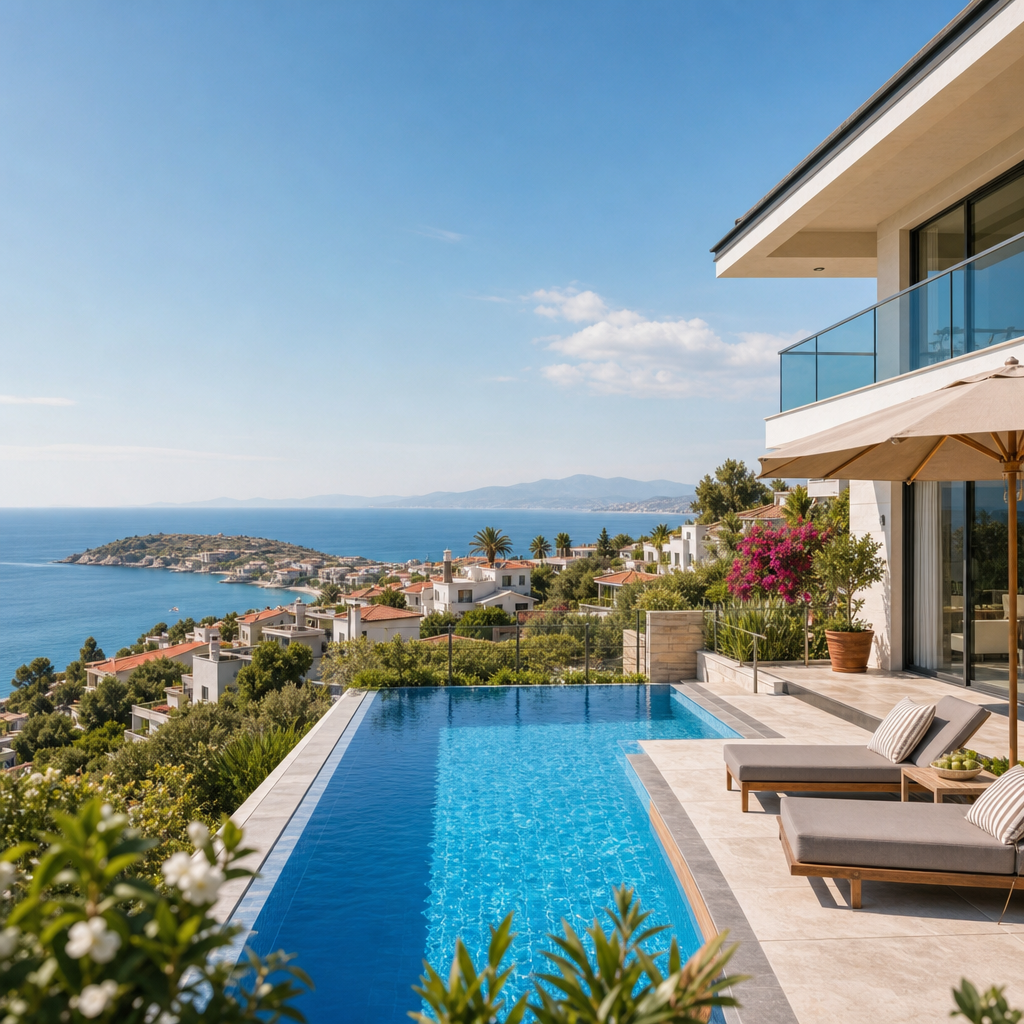
The short answer to why buy property on the Turkish Aegean coast is that few Mediterranean destinations combine this much coastline, an established tourism economy and comparatively accessible prices with clear legal routes to freehold ownership, a residence permit and, at higher investment levels, Turkish citizenship. From Izmir down towards Bodrum, the coast offers sandy beaches, historic sites and year-round amenities, with resort towns such as Kusadasi sitting within easy reach of two international airports. For UK and European buyers, overseas investors and retirees, the real decision is not whether the region is appealing, but whether its mix of lifestyle, legal framework, costs and potential returns fits your long-term plans.
We are Property Kusadasi, a licensed local estate agency working with international buyers since the early 2000s, and this guide sets out the mechanisms, options and decision criteria in plain terms so you can judge that fit for yourself.
Table of contents
Who this guide is for
Three groups tend to reach this decision from very different starting points, and the balance of priorities shifts for each.
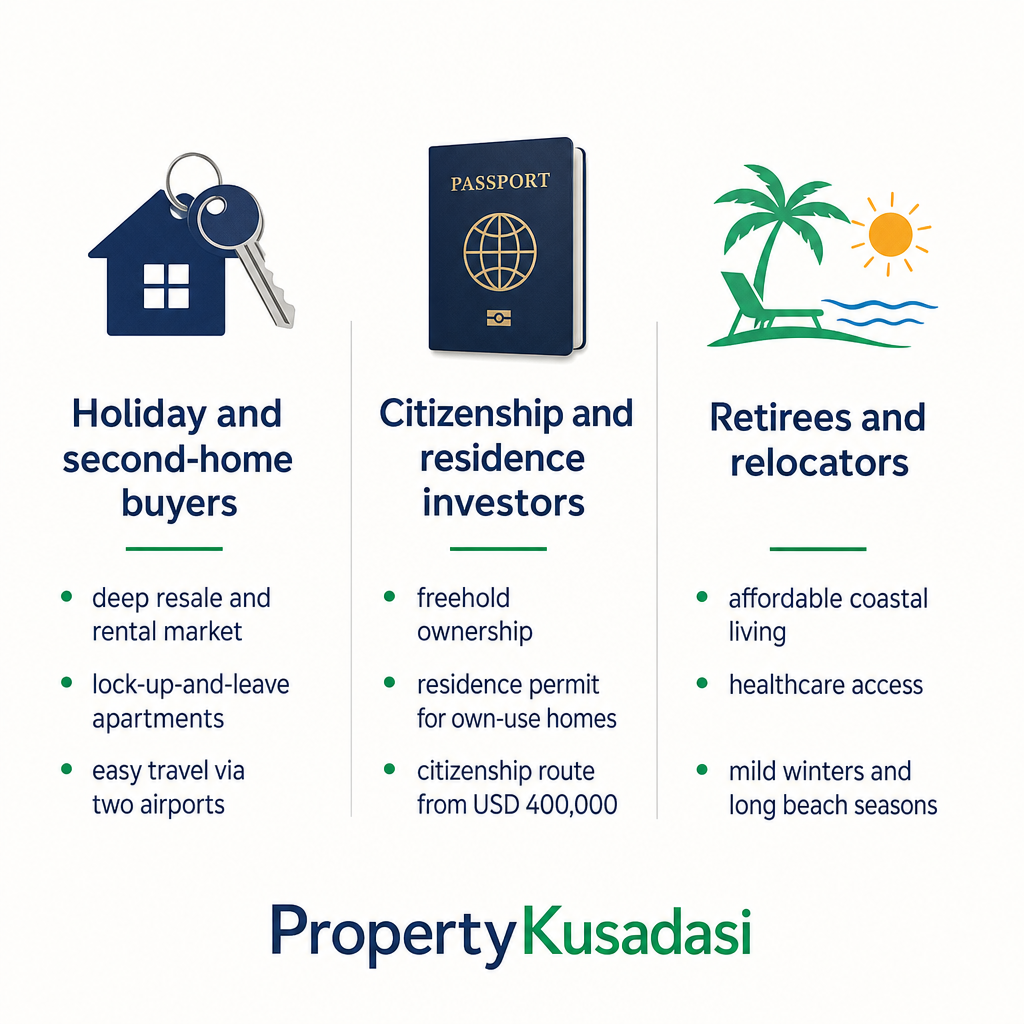
The first is international and overseas buyers looking for a holiday or second home on the Aegean coast, especially in and around Kusadasi, where a deep resale and rental market makes a property practical to use, let or eventually sell. The second is foreign investors using real estate to qualify for Turkish citizenship by investment or a residence permit in Turkey. The third is retirees and lifestyle relocators drawn by affordable coastal living, good healthcare access and a lower day-to-day cost of living than much of Western Europe.
Whatever your category, the core question is the same: does property for sale in Kusadasi genuinely serve your purpose, immigration goals, budget and appetite for managing an asset abroad? The sections below give you the facts to answer that rather than a sales pitch.
What makes the Aegean coast and Kusadasi attractive
The Aegean region enjoys hot summers and mild winters, long beach seasons and an outdoor culture built around promenades, cafes and marinas. Kusadasi itself is a major cruise and holiday port close to UNESCO-listed Ephesus, with established tourism infrastructure and neighbourhoods ranging from central seafront districts to quieter hillside villa areas. It is served by Izmir Adnan Menderes Airport and Bodrum-Milas Airport, giving regular direct and connecting flights from the UK and across Europe, which underpins both short-term rentals and easy travel for second-home owners.
Price positioning is a decisive factor. Across Kusadasi and the wider Aegean, entry-level apartments are typically priced well below equivalent coastal markets in Western Europe, while detached villas with pools remain comparatively accessible relative to neighbouring hotspots such as Bodrum. That combination of an established tourism economy and lower entry prices is a large part of why many overseas buyers choose the Turkish Aegean coast over other Mediterranean regions.
The stock is varied. Buyers can move between apartments in managed complexes with pools, security and parking; detached and semi-detached villas with private or communal pools and sea or nature views; and villa-zoned land plots for custom builds. Neighbourhoods map onto these choices well: central districts such as Türkmen and Ege Mahallesi sit close to the seafront and marina; established beach areas like Ladies Beach and Long Beach mix older apartments with newer seaview developments; and hillside zones such as Soğucak and Güzelçamlı offer detached homes with calmer surroundings. Our own portfolio reflects this range, with freehold villas, apartments and lands across Kusadasi and other coastal locations including Didim, Bodrum and Izmir.
How foreigners buy property in Turkey
Foreigners may buy and own property in Turkey under Article 35 of the Land Registry Law, provided they are citizens of a country authorised by Presidential decision and the property lies outside military forbidden zones and security areas. Two statutory limits apply: a single foreign individual may own at most 30 hectares nationwide, and foreign ownership may not exceed 10% of privately owned land in any given district. Within those limits, foreign buyers acquire full freehold title, the tapu, recorded at the Land Registry for residential, commercial and land plots.
You do not need a residence permit as a precondition to buy. Purchases can be completed while in Turkey on a standard short-stay visa, as long as Land Registry requirements are met. What you cannot do is acquire property in military restricted areas or certain strategic zones, and all sales must comply with local zoning plans.
Several practical requirements have become standard for foreign buyers and are worth understanding before you commit funds:
- A certified valuation (expert report) is often required for sales to foreigners, supporting both tax assessment and a fair market value.
- Land Registry transfer tax is charged at 4% of the declared sale price, customarily shared between buyer and seller and frequently negotiated.
- Purchase funds must be converted into Turkish Lira through a Turkish bank, and buyers obtain a Foreign Exchange Purchase Certificate (Döviz Alım Belgesi, DAB) proving that their foreign currency entered the Turkish banking system.
Because these rules and administrative practices evolve, a local agency working alongside a Turkish or English solicitor keeps overseas buyers aligned with current regulations rather than last year's version of them. For a fuller walk-through of the process, our companion explainer on buying property in Turkey as a foreigner goes step by step through documentation and registration.
Residence permit and Turkish citizenship by investment
Ownership opens two distinct immigration routes, and confusing them is a common and costly mistake.
Under Law No. 6458, foreigners who own property in Turkey and use it for their own accommodation may qualify for a renewable short-term residence permit based on property ownership. The property must be residential and actually used by the applicant; purely investment or fully rented-out units do not qualify. It must also meet minimum value thresholds set locally and sit in a neighbourhood that is not on the closed list (kapalı mahalle), where new foreign residence registrations are restricted. Owners register their address with the civil registry and then apply online, submitting the tapu, insurance and supporting documents. A suitable apartment or villa in Kusadasi can therefore support a residence permit for buyers who intend to live or retire locally.
Turkish citizenship by investment is a separate, higher-value programme. The key statutory requirement is a minimum real estate investment of USD 400,000 (or the equivalent in foreign currency), through a single property or several properties whose combined value meets or exceeds the threshold. To qualify, the property must have condominium ownership or condominium easement, or be registered land with a building on it; an annotation must be placed on the title deed confirming that the property will not be sold for at least three years; and payment must be made in cash, with the transaction verified by the Ministry of Environment, Urbanisation and Climate Change before citizenship can be granted. Higher-value villas or a carefully assembled portfolio can reach this threshold, provided the legal conditions and valuations are managed correctly from the outset.
Choosing the right property: apartments, villas and land
The property type you pick usually follows from your purpose rather than the other way around.
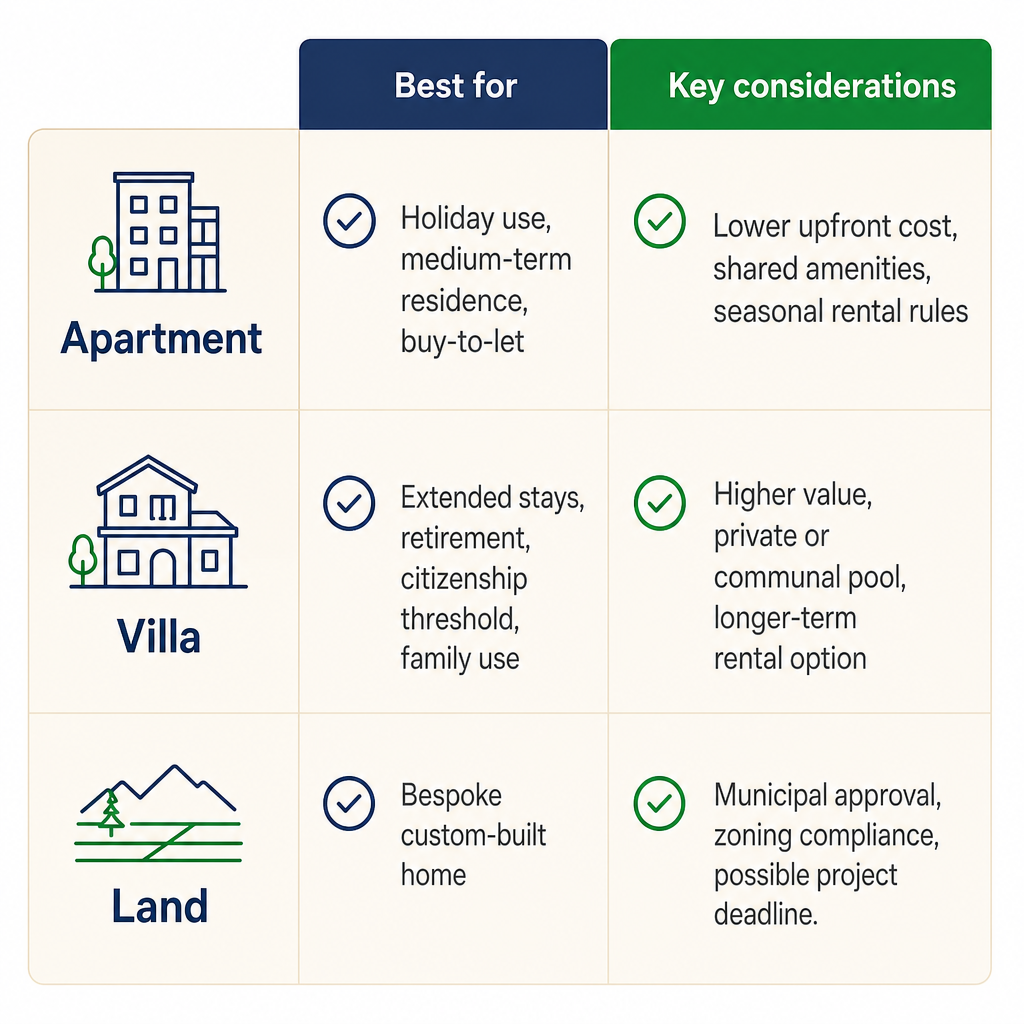
Apartments are the common entry point, with lower upfront costs and simpler management. Modern developments in Kusadasi typically include shared pools and landscaped gardens, on-site security and parking, and proximity to beaches, shopping and public transport. That makes them well suited to holiday use, medium-term residence permits or short-term rentals during the peak summer season, subject to licensing and tax rules.
Villas answer a different brief. Detached and semi-detached homes with private or communal pools are widely available around Kusadasi, particularly in hillside and coastal neighbourhoods such as Soğucak and Güzelçamlı. Buyers tend to choose them when they plan extended stays or retirement, need more bedrooms for family use, or want a higher-value asset that can support the citizenship threshold. Villas also lend themselves to longer-term rentals to families or groups alongside personal use.
Land is the route for a bespoke home. Villa-zoned plots around Kusadasi allow custom designs, chosen materials and layouts, subject to municipal approval and compliance with zoning plans. This path carries specific legal obligations, and in some cases a project must be submitted within a set time frame, so it is the option where working with local experts and legal counsel matters most.
Is buying on the Aegean right for you?
International buyers weighing a purchase on the Turkish Aegean coast, and in Kusadasi specifically, usually balance a handful of factors:
- Purpose: holiday home, retirement base, pure investment or a blend of these.
- Immigration goals: whether you need only a residence permit, or are aiming for citizenship.
- Budget and financing: comfort with pricing, running costs and potential currency movement.
- Risk appetite: tolerance for regulatory change, market cycles and managing a home abroad.
- Lifestyle fit: resort living, cultural environment, healthcare access and travel links.
Kusadasi tends to suit buyers who value an established resort atmosphere, a strong sense of community and a balance of affordability and amenity, rather than ultra-luxury seclusion. If your priorities lean towards a lively, well-connected coastal town with varied stock across budgets, the match is strong; if you are seeking remote privacy above all, other profiles may fit better.
Key risks and how to manage them
Even in a favourable environment, a few risks deserve deliberate attention rather than optimism.
- Regulatory and zoning risks. Property in military forbidden zones or security areas cannot be sold to foreigners at all, and foreign ownership in each district is capped at 10% of private land. Buying in a neighbourhood closed to new foreign residence registrations can quietly undermine plans for a residence permit.
- Documentation and valuation risks. Incomplete paperwork, inaccurate floor plans or outdated building approvals can stall a purchase at the Land Registry or municipality. Professional due diligence and a proper valuation reduce these problems before they surface.
- Citizenship and residence compliance. Not every property meets the criteria for citizenship or for a property-owner residence permit, particularly where value thresholds or usage requirements are not satisfied. Confirm eligibility against the specific unit before you rely on it.
- Market and currency risks. As in any emerging market, prices and rental demand can fluctuate, and foreign buyers carry exposure to movement in the Turkish Lira against their home currency.
Working with a long-standing local agency and engaging a qualified solicitor is a practical way to identify and mitigate these risks through careful property selection, contract drafting and title registration. The UK government's guidance on buying property in Turkey is a useful independent reference to read alongside professional advice.
How we support overseas buyers
We position ourselves as a transparent, client-focused consultancy for international buyers in Kusadasi and across Turkey, and our role runs from the first conversation to long-term ownership.
We match buyers with suitable property for sale in Kusadasi, including apartments, villas, hotels and lands, based on budget, lifestyle and investment goals. We organise viewings and local orientation so you can compare neighbourhoods and developments first-hand. We coordinate the legal process with Turkish or English solicitors, from the reservation agreement through to tapu transfer and Land Registry registration. Where clients seek a residence permit or citizenship-linked investment, we advise on property selection that aligns with official requirements, in coordination with legal specialists.
All the properties we list are freehold, all sales proceed through a solicitor with proper legal checks, and we maintain price guarantees so that buyers do not pay more than direct-from-developer rates. After completion, our after-sales services cover furniture packages, insurance, rentals, airport transfers and property management, which is exactly the practical support non-resident owners need to run a home from abroad. For buyers wanting a diversified portfolio, we also operate in Didim, Bodrum, Izmir, Antalya, Alanya and Istanbul.
If you are considering living or retiring in Kusadasi, or investing for citizenship, the sensible next step is to tell us your purpose, budget, timing and immigration goals so we can prepare tailored options and, when you visit, a viewing plan built around them.
Frequently asked questions
Can foreigners buy property in Kusadasi and elsewhere on the Aegean coast?
Yes. Most EU and UK nationals, along with many other foreign citizens, can purchase freehold property in Turkey, including Kusadasi, provided the property is not in a military forbidden zone or security area and district-level foreign ownership limits are respected.
Do I need a residence permit in Turkey before buying a property?
No. Foreign nationals do not need a residence permit as a precondition to buy real estate in Turkey. Purchases can be made while visiting, and ownership itself can later support a renewable short-term residence permit when the property is used for accommodation.
What is the minimum investment for Turkish citizenship by investment via property?
The current threshold is at least USD 400,000 (or the equivalent in foreign currency) invested in qualifying real estate, with an annotation that the property or combined properties will not be sold for three years. It can be met with a single high-value villa or several properties, provided all meet the legal conditions.
Is property in Kusadasi freehold?
Kusadasi's mainstream residential market operates on freehold ownership, and every property we offer is freehold, with title registered at the Land Registry.
What ongoing costs should I expect after buying?
Typical ongoing costs include annual property tax, site maintenance fees for units in complexes, utilities, mandatory earthquake insurance (DASK) and optional home insurance. If you let the property, additional licensing and tax obligations apply.