 EN
EN DE
DE RU
RU FR
FR AR
AR FA
FA NL
NL ES
ES FI
FI SV
SV DA
DA ZH
ZH ZH-HK
ZH-HK

Buying your first home on the Turkish Aegean coast is very achievable, and this first time buyer guide to Kusadasi property walks you through exactly how it works — from your first viewing to the moment your name is written on the title deed. As a licensed local agency working in Kusadasi since 2001, we help international buyers understand the mechanics, avoid the common pitfalls, and match a property to a clear goal: a holiday flat, a full-time home, a rental investment, or an asset that supports Turkish citizenship by investment.
The short answer for most first-time buyers is reassuring. Foreigners can generally own freehold property in Turkey outright, the process is well established, and Kusadasi offers a wide choice of apartments, villas and land at prices that compare favourably with many Western European coastal markets. What matters is doing the legal checks properly and structuring the purchase around your actual objective.
Table of contents
Why Kusadasi works for first-time international buyers
Kusadasi is a long-established Aegean resort town with a genuine year-round community alongside its holidaymakers and cruise traffic. Beaches, a working marina, and easy access to Izmir airport make it practical to reach and comfortable to live in, whether you visit for a fortnight each summer or move here permanently.
For UK and European buyers, the town tends to appeal in four distinct ways: a lock-up-and-leave holiday apartment near the sea, a retirement base with relatively low day-to-day living costs, a dual-use property that combines personal stays with seasonal rentals, or a strategic purchase within a wider Turkish citizenship by investment plan. Each of these goals points towards a slightly different property and neighbourhood, which is why we start every buyer conversation with the objective rather than the listing.
Because we have focused on Kusadasi and the surrounding coastal markets since 2001, we can filter what is realistically lettable, what suits full-time living, and what a future international buyer is likely to want when you eventually sell.
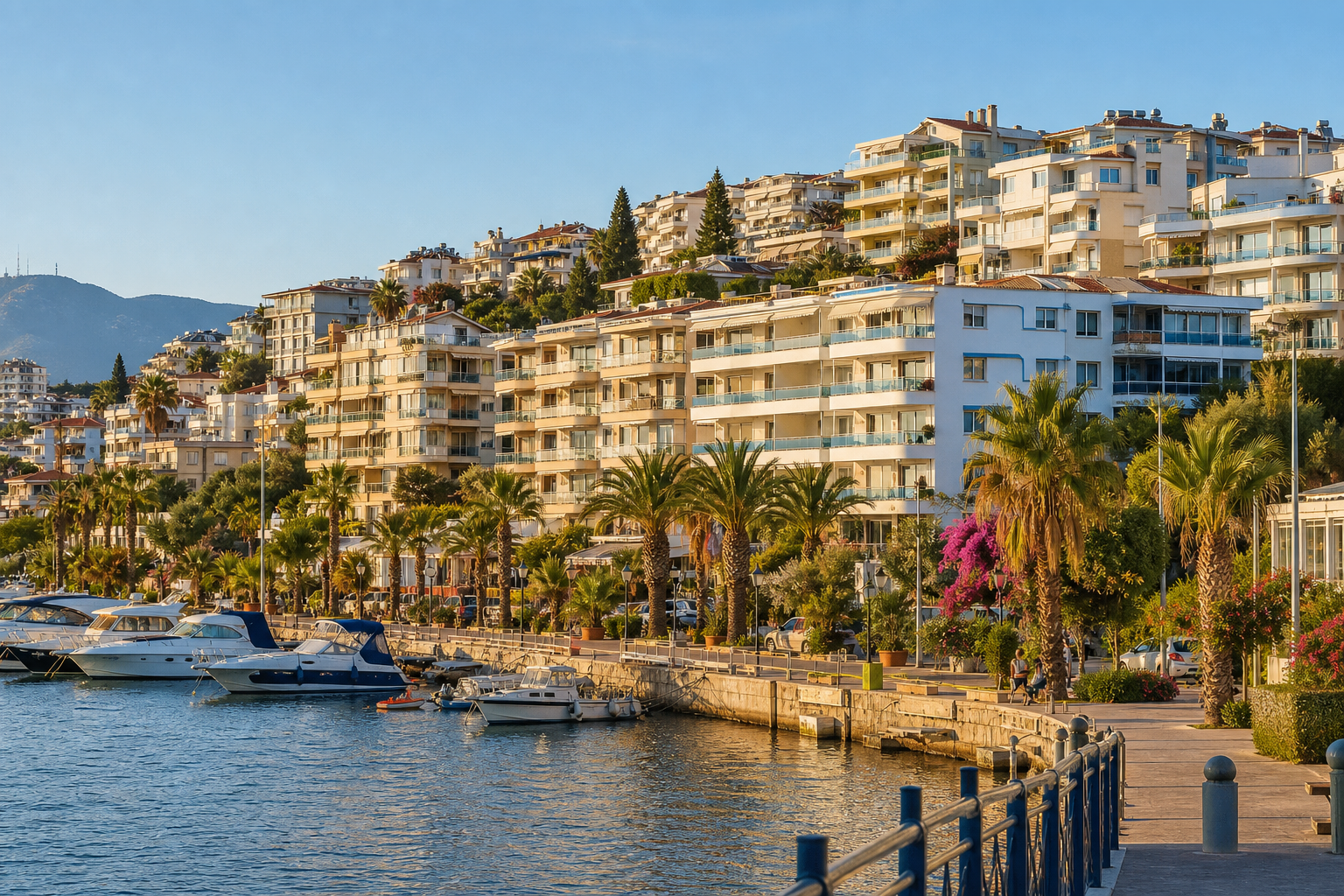
Apartments, villas or land: choosing your property type
Kusadasi's housing stock covers a broad range of budgets and lifestyles, and the right category usually follows from how much maintenance you want and how you plan to use the property.
City and harbour apartments are typically low-maintenance flats in central locations, ideal if you want to walk to shops, restaurants and the marina. Many first-time buyers begin here because the entry cost is lower and remote management is simpler.
Resort-style complexes around the popular beaches and along the Long Beach and Davutlar–Güzelçamlı corridor often include pools, landscaped gardens and on-site services. These suit holiday lets and mixed personal-and-rental use.
Villas with private gardens or pools range from compact homes on residential estates to larger properties with sea views. They appeal to relocators, retirees and higher-budget investors who want space and privacy.
Land plots exist in and around the town for buyers planning a bespoke build, but zoning, building permissions and infrastructure need careful verification at the Land Registry and municipality before you commit.
If you intend to combine living in Kusadasi with extended travel, a low-maintenance flat often makes more sense than a standalone villa; if resale to a broad market matters, mainstream locations and layouts tend to hold their appeal. We are happy to talk through apartments for sale in Kusadasi, villas with gardens or pools, or land plots for custom builds against your specific plan.
How the Turkish property system works for foreigners
The legal framework is more straightforward than many first-time buyers expect, but it has a few non-negotiable steps that protect you.
Freehold ownership and the title deed
Foreigners can generally buy freehold property in Turkey, subject to certain restrictions such as specific military or security zones, which are checked on a parcel-by-parcel basis. Ownership only transfers once it is registered at the General Directorate of Land Registry and Cadastre, where the buyer and seller — or their authorised representatives — attend together to sign and finalise the title deed (tapu).
That title record also carries annotations such as mortgages, easements or no-sale restrictions, so a careful reading of the deed is part of any responsible purchase. If you do not speak Turkish, a sworn translator must be present at the Land Registry appointment so you understand exactly what you are signing. The official Your Key Türkiye portal provides an English-language overview of procedures, documentation and eligibility for foreign purchases.
Tax number, bank account and payment channel
Most foreign buyers need a Turkish tax identification number for registration and administrative processes, plus a Turkish bank account for purchase funds and future utility or management payments. Since 2022, purchase funds are expected to move through the Turkish banking system, typically documented by a foreign-exchange purchase certificate (döviz alım belgesi) issued by a Turkish bank. For citizenship-linked purchases, bank transfer is mandatory and cash payments are not accepted.
The valuation report
A formal valuation report prepared by a licensed expert is now standard for foreign buyers and is required for any citizenship application. It confirms the official appraised value — which can differ from the asking price — and helps verify that the building complies with planning rules and permits. This matters most for citizenship: the USD 400,000 threshold is measured against the official appraised value, not the contract or listing price.
Insurance and post-purchase set-up
Compulsory earthquake insurance (DASK) must be in place before certain steps can proceed, including new utility subscriptions and, in practice, many transfers. After title transfer, buyers usually open or transfer electricity and water accounts, register the property with the municipality for property tax, and arrange payment of any complex or site management fees. We can support these after-sales tasks so a property runs smoothly even while you are outside Turkey.
The buying process from brief to title deed
Every transaction differs, but the sequence for a foreign buyer in Kusadasi is recognisable and predictable.
It begins with your brief. Defining whether you want a holiday apartment, a full-time home, a rental-focused investment, or a citizenship-qualifying asset shapes everything that follows, because it changes which properties are worth viewing. Once we understand the goal, we shortlist from our portfolio and local network and flag which units are realistically lettable and which could qualify for citizenship, subject to legal and valuation checks. Before you commit to a specific unit, the parcel's eligibility for foreign ownership is confirmed, title records are reviewed for mortgages or liens, and building permits and the occupancy certificate (iskan) are verified.
Next come viewings and contracts. We arrange in-person viewings or video tours for overseas buyers and help you compare neighbourhoods and complexes. When you choose a property, the commercial terms — price, inclusions, timescale and payment schedule — are agreed in writing, and a reservation agreement or notarial contract may secure it, often with a deposit credited against the final price. Involving a lawyer experienced in Turkish real estate to check the contract wording is prudent, and essential if the property forms part of a citizenship or residency strategy.
With a contract in place, a licensed valuer prepares the official report while you organise the foreign-exchange purchase certificate and the documented bank transfer. The title deed application is then lodged at the Land Registry. At the appointment, buyer and seller (or representatives under a notarised power of attorney) sign the transfer documents with a sworn translator present where needed, the title deed fee and official charges are paid, and the deed is issued in your name.
The relationship does not end at handover. DASK cover must be maintained and renewed, utilities and property tax managed, and any local rules on short-term letting considered before you rent. We can assist with furniture packages, property management and rentals so overseas owners can operate remotely with confidence. For a more granular walkthrough, our step-by-step guide to buying in Kusadasi covers each stage in detail.
Residence permit versus citizenship by investment
These two routes are often confused, and they carry very different thresholds and outcomes.
Buying property in Kusadasi does not automatically grant a residence permit in Turkey. However, property ownership can support an application for a short-term residence permit, subject to local and national rules on residency quotas and "closed" neighbourhoods. The Directorate General of Migration Management evaluates these applications, and requirements typically include property documents, proof of financial means, and health insurance. Our guide to the Turkish residence permit through property ownership explains this path in more depth, and we can introduce legal and immigration professionals where the route is available.
Citizenship by investment is a separate framework with firmer financial criteria. Under the real estate route, the minimum qualifying investment is currently USD 400,000, or foreign-currency equivalent, across one or more properties. The threshold is measured on the official, government-approved appraised value rather than the contract price — so if the appraisal falls below USD 400,000, the property does not qualify even if you paid more. Applicants must commit to a minimum three-year holding period, during which a no-sale restriction is annotated on the title deed. The valuation must be prepared by an SPK-licensed expert and confirmed through ministry systems, and purchase funds must move through the Turkish banking system with documented evidence.
In practice the citizenship route means acquiring qualifying property, obtaining an investor residence permit, and filing the citizenship application through the competent authority or authorised representatives. Because these rules can evolve, buyers pursuing this path should work with a specialist lawyer; we coordinate property selection and documentation in line with that legal advice.
Decision criteria and risks worth pricing in
A good first purchase is anchored on a handful of criteria and a clear-eyed view of the risks.
On location and lifestyle, weigh proximity to beaches, shops, schools and medical facilities, and be honest about year-round liveability if you intend to live or retire here rather than visit only in summer. Transport links and driving times to Izmir airport matter more than buyers expect. Our Kusadasi neighbourhoods guide sets out who tends to buy and live in each district.
On building quality and earthquake resilience, Turkey has progressively tightened its standards. Due diligence should confirm building permits and the occupancy certificate (iskan), review structural and soil reports where available, and note the age of the building and any recent renovations. DASK provides a baseline of earthquake cover, but supplementary building and contents policies are worth considering.
On legal and title risk, insist on a full title search that surfaces any mortgages, court orders or usage restrictions, confirm the property is not in a restricted zone, and use clear written contracts that set out price, payment schedule, inclusions and remedies if either party fails to perform. We work alongside legal professionals so buyers see and understand these documents before committing.
On finances and exit, factor in title deed fees, legal and valuation costs, and currency-conversion costs. Think about currency risk if rental income arrives in lira while your home expenses stay in another currency, and consider your likely future buyer from the start. Focusing on mainstream locations and property types tends to protect resale value across a broad market.
The table below summarises how the two most common ownership goals shape the checks that matter.
| Priority | Lifestyle or rental purchase | Citizenship-qualifying purchase |
|---|---|---|
| Key value figure | Contract price and rental yield | Official appraised value (USD 400,000 minimum) |
| Valuation report | Standard for foreign buyers | Mandatory, SPK-licensed, ministry-confirmed |
| Payment channel | Bank transfer recommended | Bank transfer mandatory, no cash |
| Holding restriction | None imposed | Three-year no-sale annotation on title |
| Primary adviser | Agent plus lawyer for contract | Agent plus citizenship-specialist lawyer |
How we support first-time buyers
As a licensed, long-established local agency focused on Kusadasi and other Turkish markets, we handle the parts that are hardest to manage from abroad. That means a personalised property search across apartments, villas and land aligned to your budget and goals; on-the-ground insight into neighbourhood character and rental demand; arranged viewings with honest advice on price and negotiation; legal coordination with trusted lawyers and translators for title checks, documentation, valuation and Land Registry procedures; and after-sales help with utilities, furniture, management and rentals, plus introductions to residency and citizenship specialists where your property supports those applications.
We genuinely welcome contact at the research-only stage. An early conversation is the simplest way to avoid missteps in the Turkish system and to make sure the property you fall for actually fits the goal you set. You can browse current listings on our main Property Kusadasi site whenever you are ready to compare options.
Frequently asked questions
Can foreigners buy property in Kusadasi?
Yes. Foreign individuals can generally acquire freehold property in Turkey, including in Kusadasi, subject to parcel-by-parcel checks by the Land Registry for military or special security zones.
Do I need a residence permit in Turkey to buy property?
No. Owning property does not require a residence permit, and the purchase can be completed while holding a standard visa. Property ownership can, however, support certain residence applications under current rules.
What official documents are essential when buying?
Key documents include your passport, Turkish tax number, official valuation report, title deed records, and building permits with the occupancy certificate (iskan), plus the Land Registry application forms. A sworn translator is also required if you do not speak Turkish.
What is the minimum investment for Turkish citizenship via real estate?
The current minimum is USD 400,000 in qualifying real estate, based on the official appraised value, held for at least three years under a no-sale annotation on the title deed.
Is a valuation report really necessary?
Yes. A licensed valuation report is mandatory for foreign buyers and for any citizenship case, and it also serves as an independent check on the property's value and compliance.